

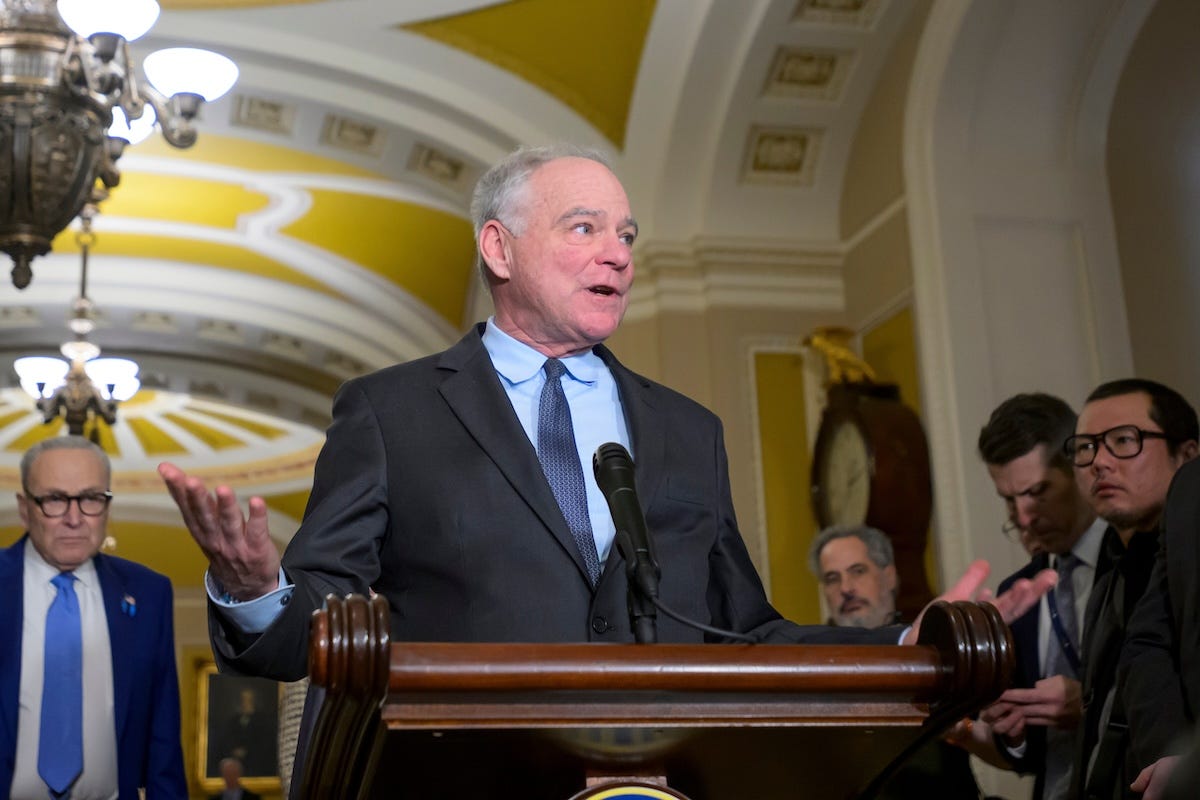
The Senate is expected to take up its most significant Cuba vote in years tomorrow. Democratic Sen. Tim Kaine plans to force action on a resolution that would bar President Donald Trump from launching new military action against Cuba without congressional approval and declare that the current U.S. oil blockade is already an act of war. It would mark one of the first serious congressional challenges to Washington’s long campaign to starve Cuba into submission.
Trump has said he wants to finish the war in Iran and that it “will be just a question of time” before he turns his attention to military action against Cuba. He has threatened that Cuba “will fall soon” and should “make a deal before it is too late.” The Pentagon, meanwhile, is reportedly ramping up planning for a possible military operation as administration officials discuss the potential kidnapping and attack of Cuban leaders.
Cuba is facing its worst humanitarian and economic crisis in decades, the result of Trump’s renewed siege and the U.S.’s decades-long effort to economically strangle the island. Trump’s genocidal fuel blockade on the civilian economy – imposed after the illegal U.S. abduction of Venezuelan President Nicolás Maduro – has intensified nationwide blackouts, fuel shortages, food and medicine scarcity, and pushed an already strained public health system further into crisis.
Trump’s threat to “take” Cuba is the latest expression of a two-century imperial ambition. Long before Trump, American presidents and officials openly imagined annexing Cuba. With the U.S. already humiliated by its failures in Iran, Washington may be tempted to reach for what it imagines is an easier target closer to home. But Cuban forces carry a real combat record, from defeating apartheid South Africa’s military in Angola to more recent roles protecting Maduro as part of his elite security detail. Even the Trump administration has cited reports that Cuban fighters are serving, in the thousands, on the frontline in Ukraine. The fantasy of an easy victory could be costly.
“That’s a big honor. Taking Cuba in some form,” Trump told reporters last month. “I mean, whether I free it, take it – think I can do anything I want with it.”
Kaine’s Cuba war powers resolution is an attempt to stop this kind of unilateral action. The legislation, S.J.Res. 124, was introduced last month by Kaine and Sens. Ruben Gallego, D-Ariz., and Adam Schiff, D-Calif., and directs “the removal of United States Armed Forces from hostilities within or against” Cuba that have not been authorized by Congress, as is constitutionally required. Rep. Nydia Velázquez, D-N.Y., introduced a version of the bill in the House.
The Cuba war powers resolution does not treat a potential invasion or bombing campaign by the Trump administration as the only form “hostilities” can take. It explicitly states that a blockade or quarantine carried out by U.S. armed forces to block oil constitutes hostilities. President John F. Kennedy himself said during the Cuban Missile Crisis that “a blockade is an act of war.” Article 42 of the U.N. Charter treats blockades as a use of armed force.
A coalition of more than 40 advocacy groups is urging Congress to act. In a letter obtained exclusively by Capital & Empire, they call on senators to back Kaine’s resolution and on the House to force a vote of its own, warning that further escalation could drive Cuba toward humanitarian collapse while putting American lives at risk in any direct conflict.
“With the Trump administration engaging in illegal acts of war such as an oil blockade — a war crime of collective punishment under international law — as well as making additional military threats, such as conducting hostile military surveillance drone flights over Cuba, Congress must act now,” the groups wrote.
Signers included groups like Action Corps, Demand Progress, and Alliance for Cuba Engagement and Respect (ACERE). The letter also notes that most Americans oppose military action against Cuba. A YouGov poll found 61 percent are against military escalation, and 46 percent disapprove of the oil blockade.
“When we saw 40 senators vote to block some weapon sales to Israel last week, we understood that number to be historic, even if the resolutions didn’t pass,” said Nathan Thompson, senior policy adviser at Just Foreign Policy, one of the advocacy groups leading the effort. “This Cuba vote should be viewed in a similar light: this is our best opportunity to press Congress to vote with the majority of their constituents, who are signing petitions and calling their senators right now, and show that this kind of indiscriminate economic warfare will not be tolerated.”
Thompson added that the political pressure extends to Republicans as well because the anti-war position is the majority in the U.S., “red state farmers want to sell their goods to Cuba, too, and nobody wants a new migration crisis.”
Cavan Kharrazian, senior policy advisor at Demand Progress, stressed that tomorrow’s vote will be “one of the most important congressional votes” on Cuba in decades. “Congress must decide whether to stop an escalating conflict or let it spiral further, forcing the Cuban people to keep paying the price,” he said.
Broad based sanctions, like the ones the U.S. has maintained on Cuba for over 60 years, kill hundreds of thousands of people every year – figures comparable to the annual death toll from armed conflict globally. A 2025 study published in the Lancet Global Health journal found that unilateral sanctions disproportionately kill babies and children younger than 5 years old.
I saw the consequences of U.S. policy firsthand when I followed an international humanitarian brigade to Cuba last month: blackouts, shortages, and a population being made to pay for Washington’s failed regime change obsession. Organizers from a number of groups, including Progressive International, Code Pink, and the Democratic Socialists of America, put together the Nuestra América Convoy – a mission of hundreds of people from around the world that converged in Havana in late March to deliver desperately needed aid and show solidarity with the country.
The entire island plunged into darkness during the trip, as the U.S. embargo took down the national electric grid. A handful of solar lamps glowed faintly, and people walked through the streets using the flashlight on their phones. I woke up one day to find that the power hadn’t returned and there was no running water in the house I was staying at. (Under the U.S. embargo, Americans traveling to Cuba are only legally allowed to stay at a handful of private five-star hotels or Airbnbs.)
I walked past playgrounds and neighborhoods that looked as if they had been bombed, the result of years of deprivation, decay, and a state starved of the resources needed to maintain basic infrastructure. Most of the regular people I spoke with – from mothers and children to the men peddling bicitaxis – told me they were hungry, surviving on just a single meal a day. Without fuel for garbage collection, trash had piled up across the city. Cubans apologized, embarrassed that many of the activists were visiting for the first time and seeing their country under these conditions. The Americans apologized for the crimes our country was committing in our name.
I spoke with a 56-year-old souvenir shop owner who had seen business dry up. She choked up talking about Trump’s threats of invasion. “When they kidnapped Maduro I was terrified,” she said, adding that U.S. military action is her biggest fear. “They’re already bombing Iran.”
Hasan Piker, a Twitch streamer and left-wing political commentator who joined the Nuestra América Convoy, described the devastation in similar terms. “I saw our 60 years of economic terrorism in action at its worst stage when I went to deliver humanitarian aid to Cuba with the Nuestra America convoy,” Piker told Capital & Empire. “For Congress, this vote is an afterthought. But for the 10 million living on this island only 90 miles off our coastline, it’s a matter of life and death.”
“Like the majority of Americans, I don’t have much confidence in our government to ever do the right thing, but after seeing the impact of our decisions firsthand – I’m praying that D.C. proves me wrong,” Piker said.