

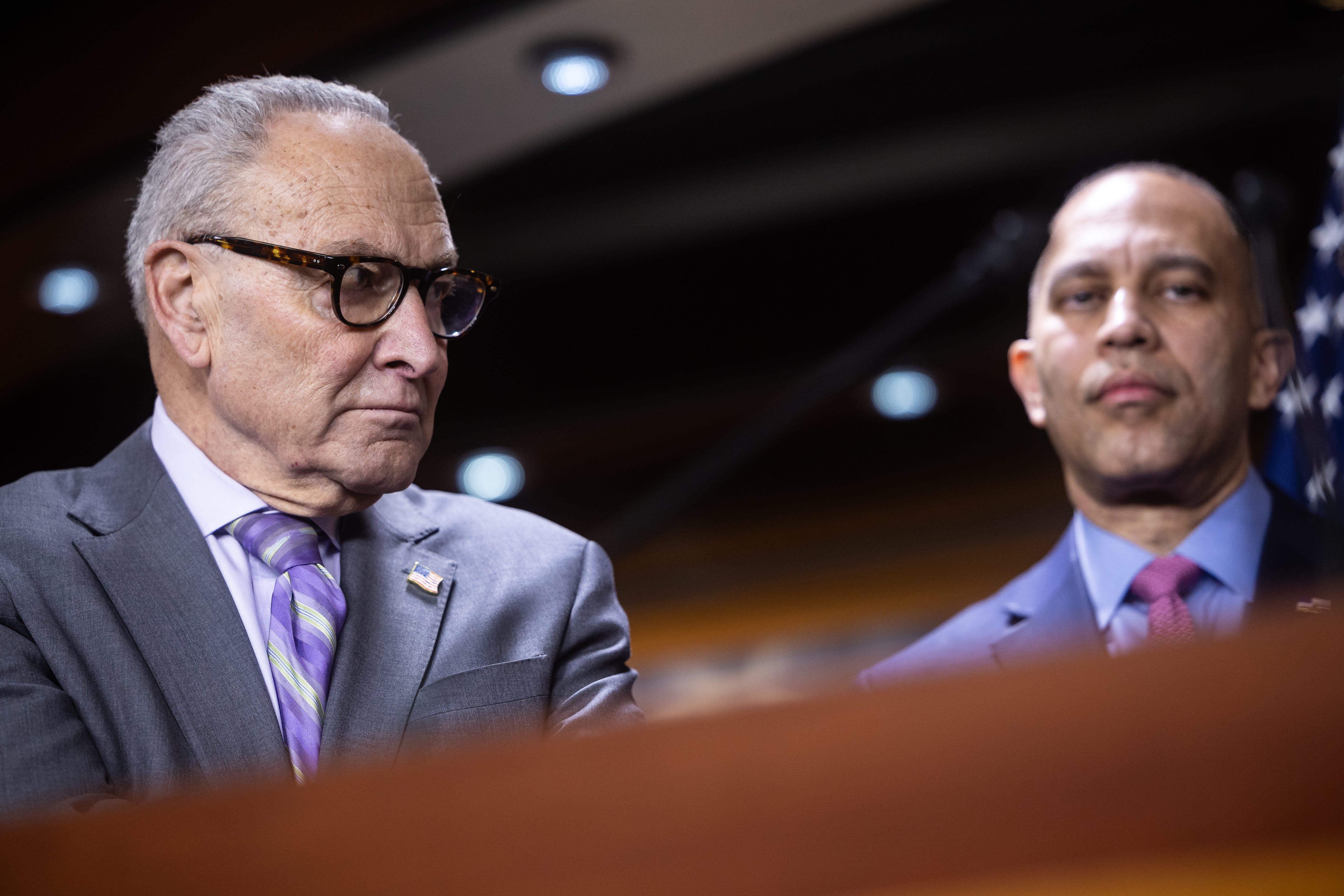
House Foreign Affairs Committee Democrats have been working behind the scenes to try to prevent a vote on Reps. Ro Khanna and Thomas Massie’s Iran war powers resolution – a measure that would require every member of Congress to go on the record about a potential U.S. war with Iran.
A top Democratic HFAC staffer, multiple sources with direct knowledge tell me, deliberately inflated projections of opposition to the bipartisan measure – warning of 20 to 40 Democratic defections – as part of a broader effort to dampen momentum and prevent the Iran war powers vote from advancing. Khanna and Massie had initially planned to force a vote on the resolution this week, but Democratic leadership is now saying they expect the vote to be delayed until next week or even later. The postponement comes as the Trump administration accelerates preparations for unauthorized military action, overseeing the largest U.S. military buildup in the region in years.
Khanna and Massie argue that Congress must weigh in before – not after – the U.S. is pulled into another regime change war in the Middle East. Their resolution would require explicit congressional authorization for any military action against Iran, a vote that could become one of the most consequential foreign policy decisions in recent congressional history.
A senior Democratic congressional staffer told me it’s “pretty clear” Democratic leadership is working to delay “or potentially sideline” the vote on the Khanna-Massie war powers resolution. “If you’ve been around the Hill, this is a familiar playbook.”
“Leadership rarely comes out and says they oppose these votes outright, because they know the underlying issue is popular with the base,” said the staffer, who works on foreign policy. “Instead, you see process concerns, timing objections, and caucus-unity arguments used to slow things down or keep members off the record. We’ve seen the same approach on past war powers votes and foreign policy amendments that clash with the national security elite consensus.”
The internal effort to sabotage momentum for the Iran war powers resolution reflects a broader strategic calculation among Democratic elites. As a recent Drop Site report detailed, many top Democrats privately believe Iran will ultimately have to be confronted militarily. But they also understand that openly backing another regime change war in the Middle East would be politically toxic. Poll after poll show there is little to no appetite for war with Iran, including lukewarm support among conservatives. The preferred outcome of many AIPAC-aligned Senate Democrats, according to a senior foreign policy aide to Senate Democratic Leader Chuck Schumer, is that Trump acts unilaterally, weakening Iran while absorbing the domestic backlash ahead of the midterms.
The war powers vote threatens to disrupt that arrangement by forcing Democrats to declare, publicly and on the record, whether they support giving Trump unilateral authority to wage war.
Schumer and Hakeem Jeffries, the top Democrat in the House, critics argue, are not leading resistance to a potential war with Iran because they fundamentally agree with the aims of the Iran hawks working inside the Trump administration. In June 2025, ahead of the U.S. strikes on Iran, Schumer attacked Trump from the right, urging the administration to be “tough” on Iran and cautioning against making any “side deals” without Israeli Prime Minister Benjamin Netanyahu’s approval.
Hill sources say Jeffries and other members of Democratic leadership are not actively whipping support for the Khanna-Massie resolution. While some committee leaders have issued statements invoking Congress’s constitutional war powers, most have declined to endorse the resolution itself, even as it is the only war powers measure up for a vote.
Unlike the run-up to the Iraq war, when the Bush administration orchestrated a sustained campaign to sell the public on invasion, the Trump administration has made little effort to construct a coherent case for war with Iran. They aren’t bothering to lie convincingly to the public. And top Democrats, mainstream media outlets, and liberal commentators have been conspicuously silent.
There has been no sustained public argument outlining a clear and immediate danger that Iran supposedly poses to the U.S. Trump has cited a shifting and incoherent mix of grievances – nuclear activity, missile capability, and regional proxy activity – without consolidating them into a comprehensive narrative like the one that preceded Iraq, even as the prospect of military action inches closer. After bombing Iran in June, Trump declared Iran’s nuclear facilities “totally obliterated.” Now, eight months later, Trump officials are claiming that Iran is “weeks away” from developing nuclear bomb-making material.
I asked Schumer’s office last week whether he supports Trump’s potential strikes, and whether escalation into a broader regional conflict is a risk he considers acceptable. His office did not respond to my request for comment. Days later, and only after the Drop Site report was published, Schumer’s office issued a minimal statement in support of congressional war powers.
So far, pro-Israel Democrats and AIPAC favorites Reps. Josh Gottheimer of New Jersey and Jared Moskowitz of Florida are the only Democrats publicly opposing the Iran war powers resolution. Gottheimer joined Rep. Mike Lawler, R-N.Y., in arguing against the resolution last week – effectively opposing even a formal debate over a conflict that could spiral into a broader regional war.
“We respect and defend Congress’s constitutional role in matters of war,” they wrote in a joint statement. “Oversight and debate are absolutely vital. However, this resolution would restrict the flexibility needed to respond to real and evolving threats and risks signaling weakness at a dangerous moment.”
Votes to invoke the War Powers Resolution are historically rare on Capitol Hill – though they have increased in frequency in recent years – and party leadership in both chambers has sought to avoid them. Passed over Nixon’s veto, the War Powers Resolution of 1973 was designed to guarantee that decisions about war reflect congressional deliberation and, by extension, the will of the American people before a president pulls the trigger. Forcing members to take a recorded position on military action carries political risk and can expose internal divisions, particularly when the White House is pressing for escalation.
But there is currently scant evidence of the mass Democratic revolt against the resolution that the HFAC staffer predicted. (The HFAC staffer referred my questions to the committee’s communications team, which did not immediately respond to my request for comment.)
“We are thinking there will likely be fewer defections than that,” said a spokesperson for J Street, a pro-Israel group that opposes war with Iran. “What we are hearing is that more and more members are committing to support the War Powers resolution due to Trump’s inching toward war.”
“Leadership will always bluff to try to scare the sponsors from calling the vote,” an organizer at an advocacy group opposing Iran strikes told me. “In reality, Moskowitz and Gottheimer are likely to be quite lonely.”
“Democratic leadership is putting in about as much energy into stopping this war as they did into pressuring Biden to rejoin the JCPOA – which is to say, almost zero,” said the organizer, who works closely with Democratic offices. “It’s obvious they’re not going to fight to protect Iranian lives if that means helping Trump avoid a war that will crater his popularity.”
Even Rep. Debbie Wasserman-Schultz, a staunch pro-Israel Democrat from Florida, has flipped on the issue. She supported Trump’s strikes on Iran in June but is now publicly against unauthorized war with Iran. “Make the case to the American people. Make the case to Congress,” Wasserman-Schultz said in an interview on MSNBC. “We have not seen anything about an imminent threat that would necessitate a significant strike.”
Republican Rep. Warren Davidson of Ohio has voiced a similar concern from the right, warning that the U.S. doesn’t “need to participate in all the wars we’re invited to, regardless of who plans them for us.”
The recent Venezuela vote also offers a useful comparison. When lawmakers were asked to weigh in on another unauthorized military action just weeks ago, Democrats did not defect en masse. The Venezuela war powers resolution failed by a narrow margin in both the Senate and the House. In the Senate, Vice President JD Vance cast a tie-breaking vote to effectively kill the resolution.
Pentagon officials are privately warning that a war with Iran could mean significant casualties, munitions shortages, and a drawn-out regional conflict. Democratic leadership seems prepared to live with that – they’d just prefer not to sign their names to it.