

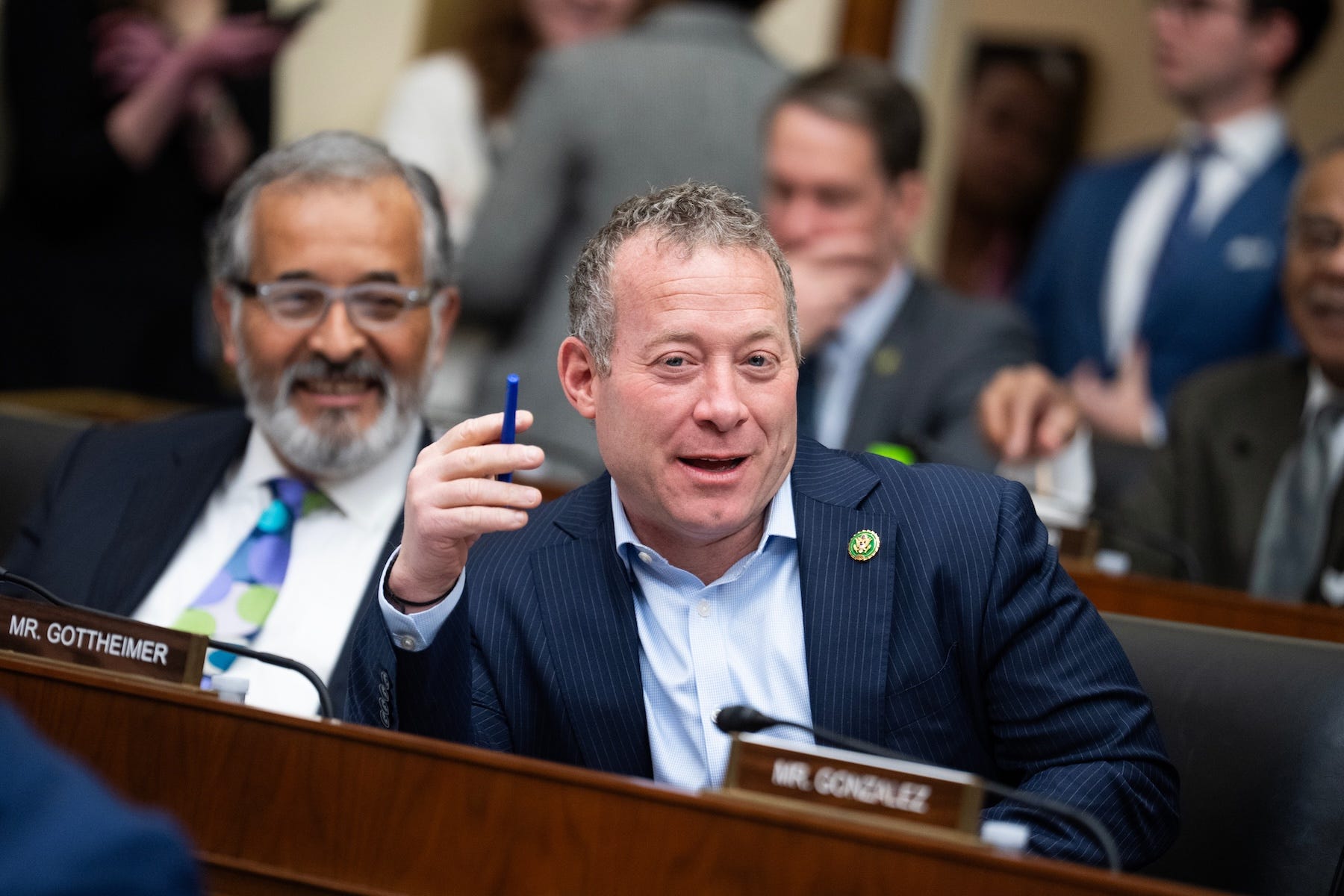
A House resolution introduced by one of the Democratic Party’s most hawkish members to blunt anti-war momentum could soon force Congress to vote on ending the U.S.-Israel war with Iran – and advocacy groups are demanding that he trigger the vote immediately.
The resolution was introduced by Rep. Josh Gottheimer, D-N.J., as the moderate, pro-Israel alternative to the earlier bipartisan effort to end U.S. involvement in the war – led by Reps. Ro Khanna and Thomas Massie – which fell just four votes short of passing in the House. Gottheimer’s measure, H.Con.Res. 75, was a narrower alternative intended to garner support from some of the Democratic Caucus’ most staunch allies of Tel Aviv.
The maneuver may now be coming back to haunt the war machine. The AIPAC Democrats who co-sponsored Gottheimer’s bill after voting to defeat the Khanna-Massie resolution could soon face a simple question if the measure reaches the floor. Are they prepared to vote against their own bill – publicly backtracking on their one-month war pledge – or support a measure that would force the administration to end the war on March 30?
Gottheimer helped launch the opposition campaign to the Khanna-Massie Iran war powers resolution, coming out against the measure and effectively opposing even holding a formal debate over the conflict. Shortly after, Gottheimer and eight other House Democrats introduced their own watered-down war powers resolution requiring President Donald Trump to halt U.S. military operations against Iran within 30 days from February 28, unless Congress authorized them.
At the outset of the war, the 30-day window served as a convenient delay mechanism. Because it roughly matched the timeline Trump initially claimed the operation would take, the measure allowed lawmakers to dampen momentum behind the Khanna-Massie resolution while giving the administration room to carry out the campaign. Now, with the conflict escalating and the clock nearing its deadline, that same timeline is creating pressure for Congress to decide whether the war should continue at all.
This alternate war powers resolution will soon become eligible for a privileged vote on the House floor, allowing lawmakers to force a vote even if leadership does not schedule one. Gottheimer’s resolution, which was formally introduced earlier this month, is set to ripen on March 19. The bill’s co-sponsors say they will force a vote the week of March 23.
In other words, the same resolution introduced to slow anti-war momentum will soon become another vehicle for forcing Congress to vote on ending the war.
Gottheimer’s resolution is backed by eight Democrats: Reps. Greg Landsman, Henry Cuellar, Jared Golden, Jim Costa, Jimmy Panetta, Vicente Gonzalez, Tom Suozzi, Adam Gray.
Of the four Democrats who voted to defeat the Khanna-Massie resolution, three of them are original co-sponsors of Gottheimer’s bill. Gottheimer himself later flipped and voted for Khanna’s measure after facing intense grassroots pressure.
A Republican congressional staffer, speaking on the condition of anonymity, told me that the Gottheimer resolution’s March 30 cutoff could actually make a vote to end the war “more appealing” to GOP lawmakers.
“Based on conversations I’ve had at the staff level,” the staffer said, the time constraint of the resolution could make it “more appealing since it gives Trump some leeway while aligning with at least some of his statements that he wants this wrapped up soon.”
A coalition of peace groups is calling on Congress to force immediate votes on pending war powers resolutions like Gottheimer’s, according to a letter exclusively obtained by Capital & Empire. Rep. Gregory Meeks, the top Democrat on the House Foreign Affairs Committee, has recently said he will wait for 60 days to force a vote on his own war powers resolution.
The letter, which was signed by over 40 groups, urges lawmakers to refuse to fund the unauthorized U.S.-Israeli war against Iran and argues that the destruction of civilian and governmental infrastructure risks triggering long-term state collapse similar to what occurred in Iraq, Syria, and Libya after Western-backed military interventions.
“Congress must not fund these operations, must reject any suggestion that appropriations can substitute for authorization, and must bring available War Powers Resolutions to a vote urgently,” the groups said.
I asked Gottheimer’s office whether he still plans to force a vote on his war powers resolution the week of March 23 and whether he would consider moving the vote forward to when the measure first becomes eligible for floor consideration, given the urgency of the war. His office did not immediately respond to a request for comment. I also asked Meeks’ office why he wants to wait 60 days before forcing a vote, even as the situation rapidly deteriorates. His office did not immediately respond.
Much of the discussion among Democratic lawmakers has centered on whether the Trump administration has articulated clear “objectives” or a coherent strategy for the war. The advocacy groups argue that focusing on whether the administration has a coherent plan effectively turns opposition to the war into a critique of how the war is being managed rather than whether it should continue.
After a recent classified briefing, Democratic Sen. Chris Murphy criticized the administration’s “incoherent” war plans and warned the strategy could amount to endless bombing. Murphy also noted that officials told members of Congress that regime change was not among the war’s objectives – a point he raised as evidence of the administration’s flawed strategy. In Murphy’s telling, that means the U.S. could spend “hundreds of billions of taxpayer dollars,” lose American lives, and still leave Iran’s current government – or an even more anti-U.S. one – in power.
The critique echoed a familiar line among Democrats in Washington – that the problem with Trump’s illegal foreign interventions is not necessarily the interventions themselves, but that they don’t go far enough to reshape the governments they target, an argument that liberals made during Trump’s attacks on Venezuela as well.
“There is no credible military strategy that could justify this particular war,” the letter continued. “There is zero evidence that Iran posed an imminent threat to the U.S. Iran previously adhered to the Joint Comprehensive Plan of Action (JCPOA), and negotiations were underway to strengthen a nuclear agreement when these hostilities began — one that experts agreed would effectively constrain Iran’s nuclear program.”
In addition to the call for immediate votes, the groups also demand “full transparency on U.S. casualties, base damage, and the financial costs of continued hostilities,” and for members to oppose all funding for these unauthorized military operations. Demand Progress, the National Iranian-American Council (NIAC), and the Quincy Institute for Responsible Statecraft are among the signers.
The first six days of the U.S. war with Iran cost more than $11.3 billion, according to Pentagon estimates shared with lawmakers – though the true cost is almost certainly far higher. Some Democrats haven’t ruled out supporting a multibillion-dollar funding boost as the war escalates either.
But under U.S. law, funding a military operation does not by itself authorize combat operations. Section 8(a) of the War Powers Resolution states that authority to introduce U.S. armed forces into hostilities cannot be inferred from appropriations or other legislation unless the law specifically authorizes the use of force.
Trump has repeatedly suggested the war may be nearing an end. But getting Iran to agree to stop firing missiles and drones, and to unblock the Strait of Hormuz, would require a negotiated settlement with significant concessions from Washington, as Iran retains substantial leverage over the U.S. and the global economy. A quick end to the conflict is unlikely to come on terms dictated solely by the U.S.